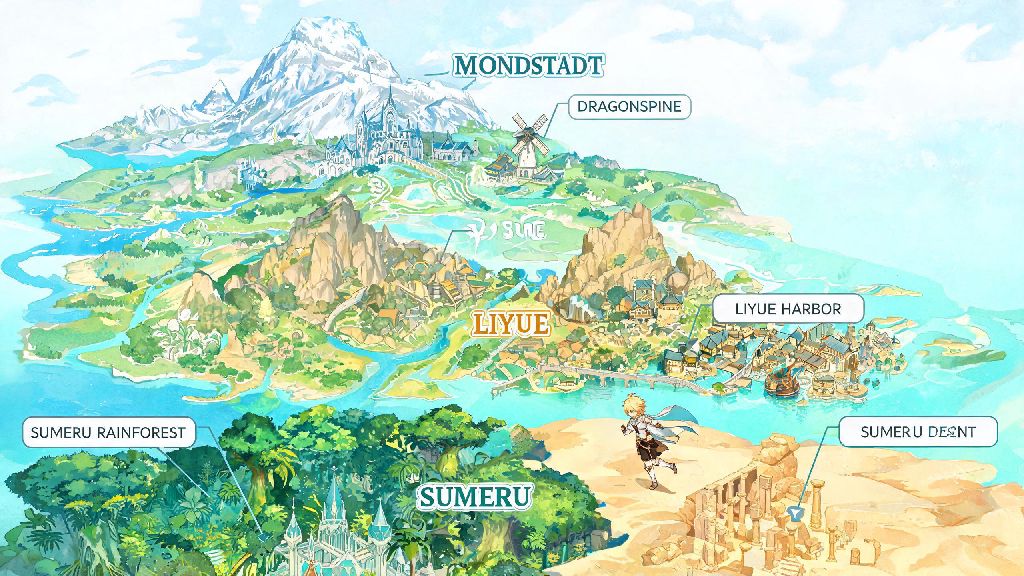
If you’ve ever spent two hours trekking from the northern tip of Mondstadt to the southern edge of Sumeru just to farm a handful of ascension materials, you’ve probably wondered how big is Genshin Impact map actually. HoYoverse has added new major regions every 6 to 12 months since the game launched, so the total playable space keeps growing year over year. This guide breaks down accurate size measurements for released regions, real-world and cross-game comparisons, upcoming unreleased areas, and easy tips to explore the whole map without wasting time.
How We Measured How Big Is Genshin Impact Map (Accurate Numbers)
Most size estimates you’ll find online are based on a simple, reliable method: using the Traveler’s confirmed movement speed to calculate distance. We know the average running speed for a playable character is roughly 1.4 meters per second, so timing how long it takes to run in a straight line across a region gives us highly accurate size calculations. As of the latest version, the total overworld playable space of the released Genshin Impact map sits at roughly 72 square kilometers. That breaks down to 12 square kilometers for Mondstadt, 18 for Liyue, 10 for Inazuma (split across its six main islands), 20 for Sumeru, and 12 for Fontaine. Underground zones like The Chasm, Enkanomiya, and Fontaine’s underwater areas add roughly 20 extra square kilometers of hidden playable space that most players forget to include when estimating total size. It’s easy to underestimate how large the map is when you use fast travel constantly, but once you turn off teleports, you’ll quickly realize just how much ground there is to cover.
Genshin Impact Map Size Compared to Real-World Locations & Other Games
Raw square kilometer numbers don’t mean much on their own, so let’s put the size into perspective. The 72 square kilometer overworld map is almost exactly the same size as the city of San Francisco, which measures roughly 75 square kilometers. If you walked the entire released overworld nonstop at an average real-world walking speed, it would take you roughly 14 hours to cover every inch. When stacked up against other popular open world games, the Genshin Impact map comes in bigger than The Legend of Zelda: Breath of the Wild’s 50 square kilometer Hyrule, and almost as big as Red Dead Redemption 2’s 75 square kilometer map. I once tried to walk from the Dragonspine summit to the southern end of the Sumeru rainforest without fast travel, and it took me just over two hours of real time, not counting stops to fight hilichurls or grab loose mora. If HoYoverse releases all seven planned Teyvat regions plus hidden endgame areas, the full Genshin Impact map is estimated to hit 150+ square kilometers, making it one of the largest open world games ever created.
What Parts of the Full Genshin Impact Map Are Still Unreleased?
Many players are surprised to learn that less than 60% of the full planned Genshin Impact map is available to play right now. We currently have five of the seven elemental regions released, with two core regions plus multiple hidden areas still in development. HoYoverse has teased most of these upcoming areas in story quests and official lore drops, so we have a pretty good idea of what’s coming next:
HoYoverse also releases temporary limited-time map areas almost every year, like the Golden Apple Archipelago summer event zones. These areas are fully explorable with their own quests, puzzles, and collectibles, so they add even more total playable space for players who join during those events. Some of these temporary zones have even been added to the permanent map later, like the Serai Island area of Inazuma that first launched as part of a limited event.
Top Tips for Exploring the Entire Genshin Impact Map Efficiently
Even with fast travel, the huge size of the Genshin Impact map can feel overwhelming, especially if you’re trying to hit 100% exploration progress in every region. These simple tips will help you cover more ground faster without burning out. First, always unlock all Statues of the Seven in a new region as soon as you gain access to it. Unlocking all Statues of the Seven should be your first priority every time a new region drops, because they reveal surrounding map terrain, heal your party for free, and give you permanent fast travel points that cut travel time by 80% minimum. Second, build a dedicated exploration team with characters that have movement passives. Characters like Yelan (fast running speed), Wanderer (short distance flight), Sayu (rolling movement for rough terrain), and Anemo Traveler (gliding speed boost) make traversing long distances feel far less tedious. Keep portable waypoints in your inventory at all times to place near rare farming spots or hard-to-reach puzzle areas so you don’t have to hike back multiple times. You don’t have to 100% every region the second it launches, either. Take it slow, explore areas as you complete story quests, and you’ll finish your exploration progress without even trying.
At the end of the day, how big is Genshin Impact map depends on how much of it you take the time to seek out. Even after playing since launch, I still find hidden chests, secret side quests, and tiny hidden scenic spots in Mondstadt that I never noticed before. The map’s size is impressive on its own, but the dense, detailed content packed into every square kilometer is what makes Teyvat feel so big and alive. Whether you’re a completionist chasing 100% exploration in every region or a casual player who just wanders around looking for pretty views to take screenshots of, there’s always something new to find across the map.